
Revenir, Retourner or Rentrer?
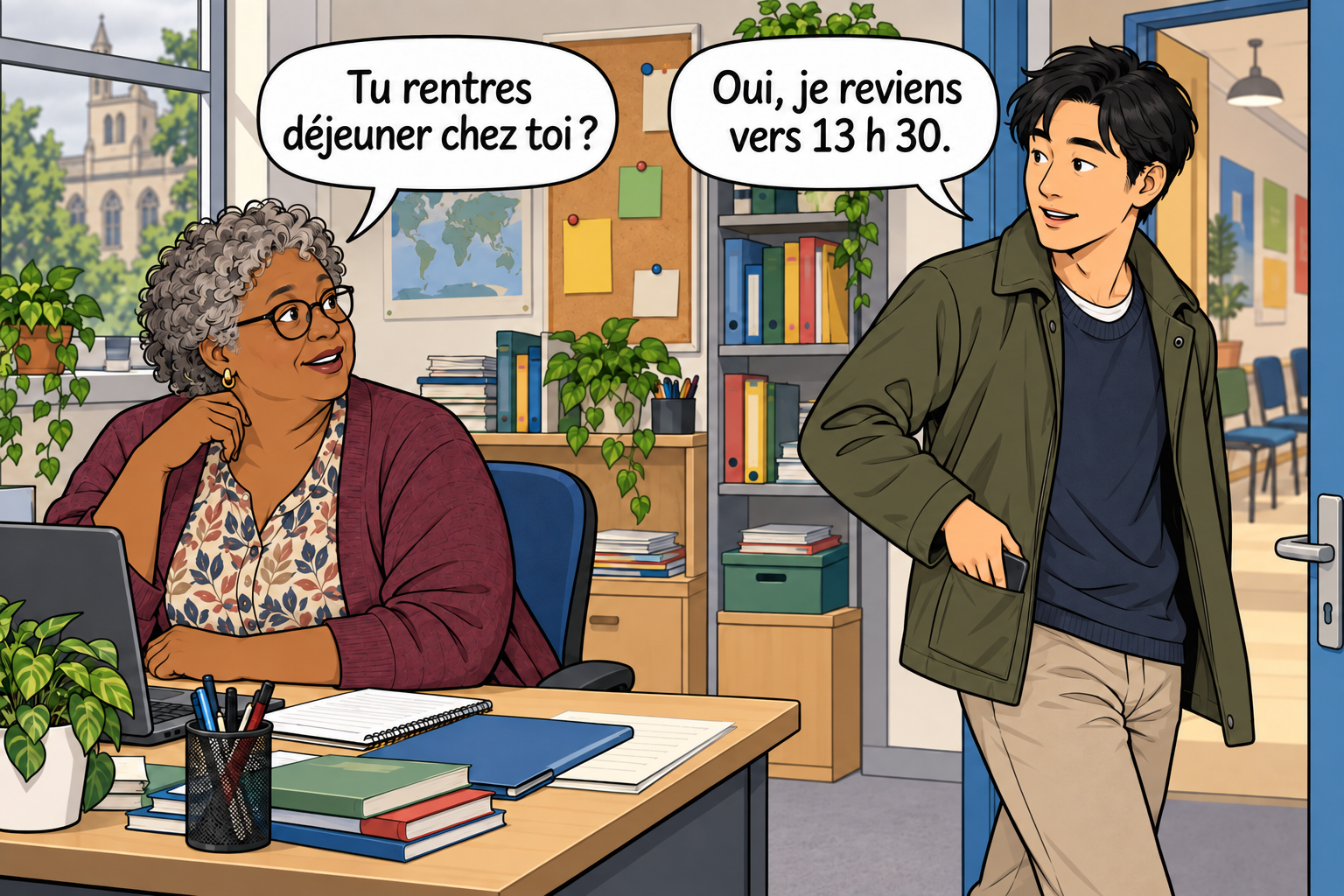
Revenir, retourner and rentrer can all translate as “to come back” or “to go back”. All three start with re‑, the idea of a return. What changes is the direction of that return.
To choose the right one, ask yourself where the speaker is. English makes a similar distinction: come back, go back and go home.
Revenir
You come back to where the speaker is.
Venir means moving toward the speaker. Revenir means coming back here: to the place where I am, or where the person I am talking to is.
- Attendez-moi ici, je reviens dans un instant.Wait for me here, I’ll be back in a moment.
- Nadia fait ses études à Bruxelles. Elle revient à Amiens pour Noël.Nadia is studying in Brussels. She’s coming back to Amiens for Christmas. (The speaker is in Amiens.)
Also: revenir sur
Followed by sur, revenir means to come back to a topic, or to go back on a decision.
- J’aimerais revenir sur ce que vous avez dit hier.I’d like to come back to what you said yesterday.
- Il est trop tard pour revenir sur notre décision.It’s too late to go back on our decision.
Retourner
You go back to a place you have already been.
Retourner works like aller: the movement goes away from the speaker, toward a place that is “there”, not “here”. That place is one you already know.
- J’ai adoré Phnom Penh, j’y retournerai dès que j’en aurai les moyens.I loved Phnom Penh, I’ll go back as soon as I can afford it.
- Après le déjeuner, elle a fait une petite marche de 15 minutes, puis elle est retournée à son bureau.After lunch, she went for a short 15-minute walk, then went back to her desk.
- Tu es déjà retourné dans la maison de ton enfance ?Have you ever been back to your childhood home?
Revenir or retourner? Ask where the speaker is.
Also: retourner quelque chose
With a direct object, retourner means to turn something over, or to turn a place upside down.
- Retournez les cartes une par une.Turn the cards over one by one.
- Il a retourné toute la maison pour retrouver ses clés.He turned the whole house upside down looking for his keys.
Rentrer
You go back home, or back to your base.
Rentrer literally means “to go back in”. Its main use is going home: to your house, your country, or the place you normally belong, such as school or work. Retourner chez soi exists, but rentrer is far more natural.
- Il est tard, je rentre.It’s late, I’m going home.
- Après trois ans en Suisse, Quentin est rentré en Bretagne.After three years in Switzerland, Quentin went back home to Brittany.
- Les enfants rentrent de l’école à 16 h 30.The children get home from school at 4:30.
Revenir or rentrer? Ask whether you are going home.
When “here” is home, both work: at home, you can say je reviens or je rentre vers 19 h.
Also: rentrer quelque chose
With a direct object, rentrer means to bring something inside.
- Il faut rentrer les plantes avant l’hiver.The plants need to be brought inside before winter.
Related forms
These forms are very common. Some belong to informal French.
| Form | Meaning and example |
|---|---|
| ça me revient | it’s coming back to me, I remember Attends, son nom va me revenir. |
| je n’en reviens pas | I can’t believe it Tu as eu ton permis du premier coup ? Je n’en reviens pas ! |
| revenir cher | to end up costing a lot Ces petites réparations finissent par revenir cher. |
| se retourner | to turn around Ne te retourne pas ! |
| retourner (à qqn) | to send back Merci de nous retourner le formulaire signé. |
| la rentrée | the return to school or work after the summer La rentrée des classes a lieu début septembre. |
| rentrer dans | to crash into familier Il est rentré dans un poteau en regardant son téléphone. |
| rentrer dans l’ordre | to get back to normal Après la panne, tout est rentré dans l’ordre. |
Rentrer or entrer?
Strictly speaking, rentrer means going back in, and entrer means going in. In everyday speech, however, rentrer is constantly used for simply going in: rentre, il fait froid ! (come in, it’s cold!), on rentre dans ce magasin ? (shall we go into this shop?) You will hear this all the time. In writing, and in more formal speech, use entrer when there is no idea of a return: Entrez, je vous en prie. (Do come in.)
Check your understanding
Choose the verb that fits each sentence. The information in brackets tells you where the speaker is. An explanation appears after each answer.